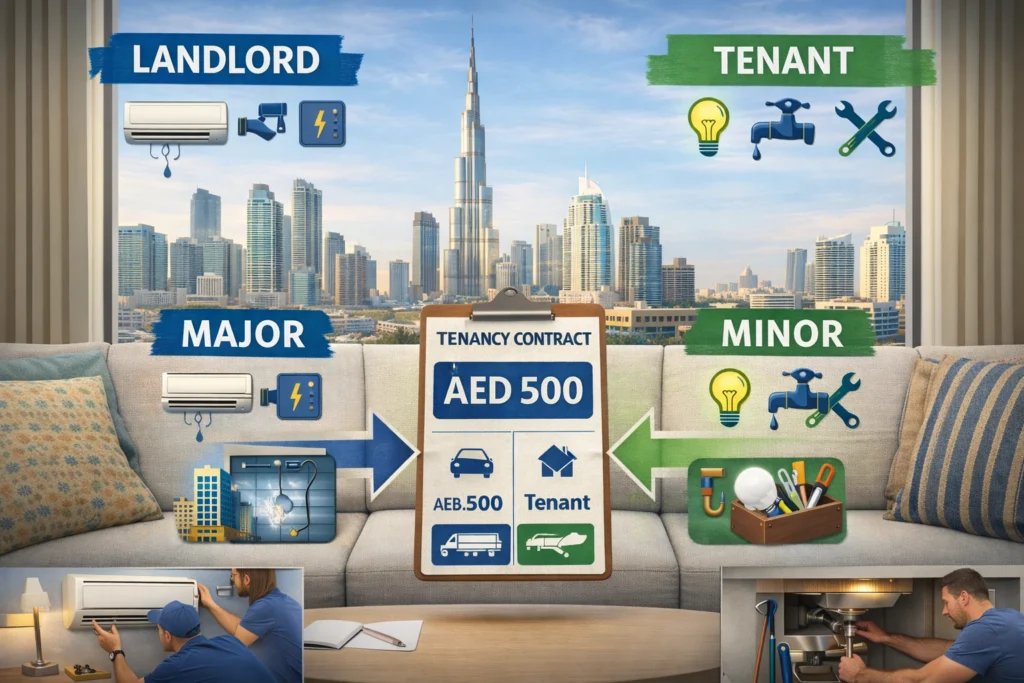
Short answer: in Dubai, the landlord usually pays for major repairs and anything affecting the property’s usability, while the tenant often pays for minor, day-to-day items and consumables—unless the tenancy contract assigns responsibilities differently.
Below is a practical way to decide who pays, plus common real-life examples.
The baseline principle
In everyday Dubai rental practice, the starting point is simple: the landlord should keep the unit in a livable, usable condition throughout the lease, fixing defects that prevent normal use—unless the contract says otherwise.
The tenant must:
- use the unit reasonably and take care of it,
- report issues promptly,
- avoid alterations or major work without written approval.
Key takeaway: always check your tenancy contract / Ejari first.
Major vs Minor: the practical split
Most disputes come down to one question: is it “minor” or “major”?
Typically landlord (major):
- AC system faults (not cooling, leaking, system failure);
- electrical system defects (DB/wiring issues, repeated tripping not caused by misuse);
- serious plumbing (hidden leaks, leaks inside walls/ceilings, building-line problems, water heater failure if provided);
- doors/windows/locks when it’s a unit defect or normal wear, not mishandling;
- structural leaks (facade/roof ingress).
Typically tenant (minor / customary):
- light bulbs, remote batteries, small consumables (often stated in contracts);
- small “tighten/replace a washer” fixes, shower hose, tap aerator;
- minor clogs clearly caused by everyday use;
- any damage caused by tenant misuse or negligence.
The clause that decides most cases: a cost threshold (e.g., AED 500)
Many leases include something like:
“Tenant pays the first AED 500 per incident; above that, landlord pays.”
This is contract-based, not a universal rule. If it’s in your contract, it’s decisive.
Common scenarios
Air conditioning (AC)
- If the AC fails as a system (not cooling/leaking/major fault), it’s usually landlord (it affects usability).
- If it’s simple upkeep assigned to the tenant (e.g., filter cleaning in the contract), it may be tenant.
Plumbing: “a small leak”
- A tiny fitting/washer fix can be minor.
- Any leak inside walls/ceilings or with risk of damage quickly becomes major—usually landlord/management.
Appliances (fridge/washer/oven)
Depends on the contract and what’s provided:
- if appliances are provided and fail under normal use, often landlord;
- misuse/overloading/incorrect operation is usually tenant.
Painting / end-of-lease cosmetics
- Normal wear and tear shouldn’t automatically become a tenant charge.
- Holes, heavy staining, unauthorized modifications can lead to deposit deductions.
Tenant’s best-practice steps (to avoid unfair charges)
- Report immediately in writing (WhatsApp/email) + photos/videos + date/time.
- Check the lease: threshold, tenant-maintenance list, response timelines.
- Don’t do major repairs yourself without approval—reimbursement may be refused.
- If water/electrical risk exists, mark it urgent and ask who will appoint the contractor.
- Keep invoices and written approvals.
Landlord tips to reduce disputes
- Define minor vs major clearly, including call-out/diagnosis fees.
- Set response timelines (e.g., urgent within 24 hours).
- Use photo handover reports + appliance inventory.
- Don’t delay repairs that affect usability—this is where conflicts escalate.
How Dubai Vista can help
Dubai Vista can support tenants and landlords by:
- reviewing lease terms (maintenance thresholds, exclusions, timelines),
- coordinating contractors and quality control,
- managing landlord–tenant communication to prevent downtime and deposit disputes.
Disclaimer: This article is for general information only and not legal advice.